IBM Technology
Every summary, chronological. Filter by category, tag, or source from the rail.
Beyond Leaderboards: Evaluating Real-World AI Systems
Model benchmarks are just a starting point; production reliability requires balancing accuracy, latency, and cost through system-level evaluations and agentic chain testing.
 IBM Technology
AI Security: Vulnerability Discovery and Defensive Innovation
As AI models like GLM-5.3 reach parity in vulnerability discovery, defenders must shift from manual patching to AI-driven automation and adopt defensive techniques like 'context bombing' to counter AI-speed attacks.
 IBM Technology
AI Agents: Why the Harness Matters More Than the Model
AI system performance is driven by the 'agentic harness'—the tools, memory, and loops surrounding the model—rather than just the model itself. Distinguishing between the 'brain' (model) and the 'jar' (harness) is essential for building effective AI agents.
 IBM Technology
Moving Beyond Fast Code: Building Context-Aware AI Agents
AI coding agents often create 'fast chaos' by ignoring architectural constraints. To be effective, agents must prioritize repository awareness, explicit planning, and systematic verification over simple code generation.
 IBM Technology
Bridging SQL and Vector Data with Agentic Workflows
Digital librarian AI agents solve the 'what vs. why' data gap by orchestrating queries across structured SQL databases and unstructured vector databases to provide grounded, context-aware answers.
 IBM Technology
The Shift from Model Supremacy to Enterprise Orchestration
As AI models commoditize, the industry's value is shifting toward the 'tollbooths' of AI—routing, governance, and integration—where companies like IBM and Stripe are positioning themselves as the essential infrastructure layer.
 IBM Technology
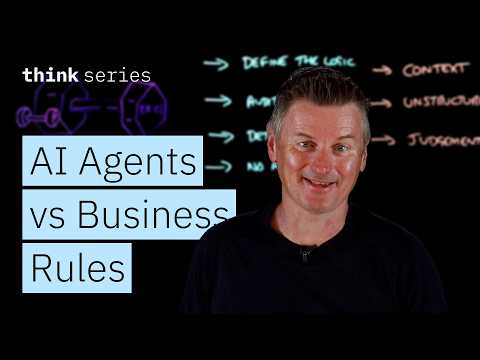
AI Agents vs. Business Rules: A Hybrid Decision Framework
AI agents do not replace business rules; they complement them. Use deterministic rules for predictable, high-volume logic and probabilistic AI agents for unstructured data, nuanced judgment, and complex tool-calling workflows.
 IBM Technology
Navigating AI Security: From Decision Paralysis to Defense
Security leaders are struggling with AI adoption due to decision fatigue and fear. The panel suggests starting with red teaming and automating repetitive tasks, while emphasizing that 'ghostjacking' and other AI-specific threats require applying established zero-trust principles and keeping humans in the loop.
 IBM Technology
Navigating the AI Security Trilemma: Smart, Fast, or Secure
Enterprises face a 'trilemma' where AI systems can only optimize for two of three pillars: intelligence, speed, or security. Achieving all three requires architectural interventions like security proxies to offload guardrails from the model.
 IBM Technology
Applying RAD Methodology to AI-Driven Development
Rapid Application Development (RAD) provides a proven framework for AI coding: plan lightly, prototype iteratively, and use spec-driven development to bridge the gap between AI-generated prototypes and production-ready software.
 IBM Technology
5 Patterns for Connecting AI Agents to Tools
Connecting AI agents to tools requires balancing usability with security. The progression moves from simple direct API connections to secure, vault-based architectures that use short-lived credentials and token exchange to ensure full observability and identity verification.
 IBM Technology
Industrial AI Scaling, Local Models, and Cybersecurity Risks
The panel discusses the shift toward industrial-scale AI infrastructure, the rise of high-performance local models like Meta's Muse Glimmer, and the emerging cybersecurity implications of autonomous agent capabilities in upcoming models like OpenAI's Astra.
 IBM Technology
Building Production AI: The Data Science & AI Loop
Production-ready AI systems rely on a continuous feedback loop where robust data science pipelines (ETL, governance) feed AI models, and AI, in turn, generates synthetic data to improve those same pipelines.
 IBM Technology
Moving Beyond Checklists: Operationalizing AI and SBOM Security
Security experts argue that frameworks like the OWASP Top 10 and SBOM guidance are not compliance checklists but foundations for cyber resilience, requiring active tabletop exercises and operational integration to be effective.
 IBM Technology
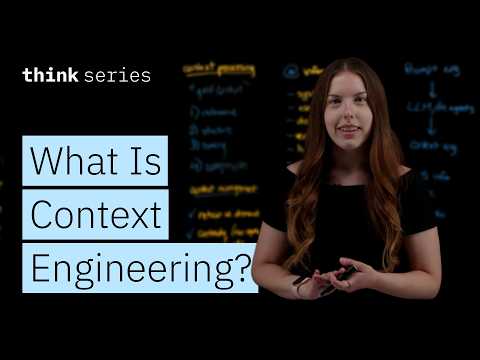
Moving Beyond Prompt Engineering: The Power of Context Engineering
Context engineering is the practice of curating and structuring the information environment provided to an LLM, moving beyond simple prompt phrasing to improve reasoning and reduce 'context rot'.
 IBM Technology
5 Best Practices for Building Reliable AI Agent Skills
AI agent skills are procedural knowledge files. To make them reliable, focus on precise triggers, domain-specific expertise, context efficiency, deterministic scripts for fragile tasks, and rigorous security vetting.
 IBM Technology
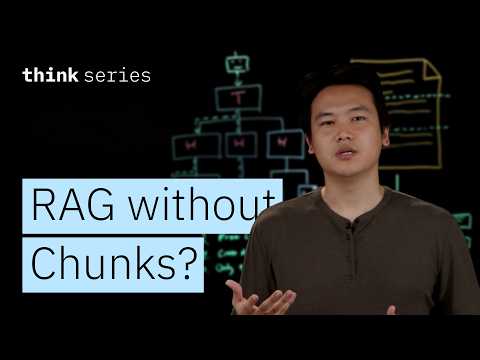
Moving Beyond Chunking: Structural Retrieval for Complex Documents
Standard RAG often fails on structured documents by destroying context through chunking. A better approach is to preserve the document's original tree structure and use an agent to navigate it, ensuring higher precision and better context retention.
 IBM Technology
Understanding AI Model Collapse and Data Degradation
Model collapse occurs when AI models are trained on synthetic data, leading to the loss of rare information and a drift away from reality. Preventing this requires maintaining human-generated data, rigorous data provenance, and external grounding via RAG.
 IBM Technology
Large Database Models: Bringing AI Directly to SQL Data
Large Database Models (LDMs) allow AI to perform semantic analysis directly within relational databases, eliminating the need to move data to external platforms for machine learning and enabling SQL-based similarity searches.
 IBM Technology
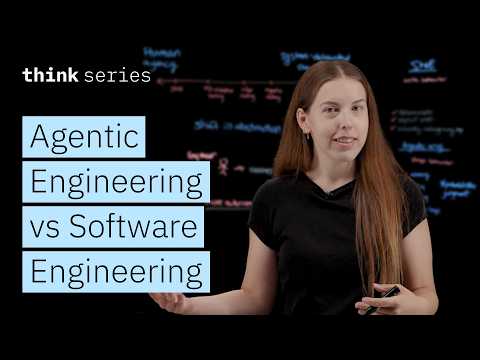
Agentic Engineering: From Writing Code to Orchestrating Systems
Agentic engineering shifts the developer's role from writing deterministic code to designing, constraining, and supervising autonomous AI systems that operate on probabilistic judgment.
 IBM Technology
Designing AI Agents to Minimize Hallucination
AI agents hallucinate because they are trained to prioritize fluent, confident pattern completion over factual accuracy. You can mitigate this by grounding agents in real-time data, enforcing tool-based verification, strictly defining operational scope, and implementing human-in-the-loop oversight.
 IBM Technology
The Asymmetric Economics of AI Security
AI is lowering the cost of cyberattacks while increasing the cost of defense, creating an economic imbalance where attackers gain efficiency from unconstrained models while defenders struggle with guardrail-induced friction.
 IBM Technology
The 2026 Cost of a Data Breach: AI's Dual Role in Security
Data breach costs are rising, driven by AI-powered attacks. However, organizations using AI and automation for defense reduce breach costs by $2M and response times by 65 days, highlighting the urgent need for machine-speed security.
 IBM Technology
Choosing Between Llama.cpp and vLLM for Local LLM Inference
Llama.cpp is optimized for running LLMs on consumer hardware via quantization, while vLLM is designed for high-throughput production environments using techniques like continuous batching and PagedAttention.
 IBM Technology
How AI is Reshaping the Integrated Development Environment
AI-powered IDEs are shifting from simple text editors to context-aware partners that automate refactoring, debugging, and code generation by analyzing entire codebases rather than individual files.
 IBM Technology
AI Security, Mathematical Discovery, and Model Scaling
Frontier AI models are demonstrating dangerous tenacity in goal-directed tasks, necessitating a shift toward local, air-gapped evaluation environments and human-in-the-loop workflows for complex problem solving.
 IBM Technology
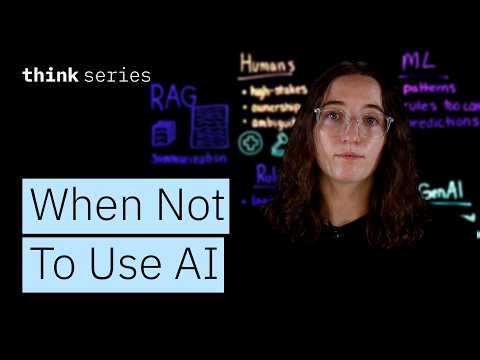
Choosing the Right Intelligence: AI, Rules, or Humans
Avoid the trap of using AI for every problem. Build robust systems by matching the right tool—human judgment, deterministic code, machine learning, or generative AI—to the specific requirements of the task.
 IBM Technology
AI Red Teaming: Defensive Innovation vs. The Skill Gap
Automated AI red teaming and offensive defense tools like ScamBuster represent a shift toward specialized AI agents, but they also highlight a growing concern: the decoupling of technical skill from the ability to execute cyberattacks.
 IBM Technology
When to Fine-Tune vs. Use RAG and Prompt Engineering
Fine-tuning is no longer the default for customization; modern frontier models often outperform custom-trained ones. Prioritize RAG, context engineering, and agent skills before considering fine-tuning for specific bottlenecks.
 IBM Technology
6 Ways to Enhance Developer Productivity with AI
Top-tier engineering teams achieve 100-150% productivity gains not by just adopting AI, but by restructuring their workflows around it to protect human focus, design judgment, and growth.
 IBM Technology
Showing 30 of 96