#ui-ux
Every summary, chronological. Filter by category, tag, or source from the rail.
Rethinking UI Through Small-Scale AI Integration
Software is shifting from rigid, deterministic interfaces to adaptive, human-centric experiences by embedding small, fast, and inexpensive AI models directly into common workflows.
The UX Failure of Exposing AI Architecture to Consumers
AI companies are forcing users to navigate complex, fragmented internal product branding instead of building intuitive, unified interfaces that simply solve problems.
RIACT: A Responsible AI Approach to Student Burnout Detection
RIACT is a student-focused tracking system that uses deterministic rules for burnout detection and constrained LLMs for coaching, prioritizing transparency and user agency over opaque diagnostic models.
Designing Grok Bot: A Journey of Iteration and Agent UX
John Bai, an early designer at Cursor, shares the iterative process behind Grok Bot, explaining why the team ultimately settled on a chat-based interface despite initial explorations into ambient, OS-native UI patterns.
 Dive Club
Design Taste for AI Agents: Avoiding 'Vibe-Coded' Slop
To build high-quality AI apps, treat AI output as a base rather than a final product. Use specific 'slop gates' to block common AI design patterns, provide visual references, and iterate using smaller, faster models.
 AI Engineer
The Rise of Agentic UI and the Mascot Industrial Complex
The hosts discuss the shift toward 'agentic' software interfaces, where visibility into an AI's computer usage—rather than just abstract tool calls—is driving mass adoption and changing how builders approach automation.
Building a Custom AI-Powered Prototyping Playground
Patrick Morgan built a custom, agent-native prototyping environment for Sublime Security that bridges the gap between static design tools and production code, enabling rapid, interactive iteration without the overhead of traditional design handoff.
 Dive Club
Google Maps Evolves into an Agentic Assistant
Google Maps is shifting from a navigation tool to an agentic assistant, enabling direct food ordering, hotel booking, and personalized planning by integrating user data from Gmail and Calendar.
Wrinkles: An AI-Powered Audio Guide for Location-Based Storytelling
Wrinkles is an AI-powered app that uses geolocation to provide hands-free, interactive audio tours, allowing users to discover local history and contribute their own personal narratives to specific locations.
Nate Parrott on Building Claude Design
Nate Parrott explains how Claude Design evolved from a personal side project into a powerful tool for rapid prototyping, enabling designers to build custom, interactive interfaces at the speed of thought.
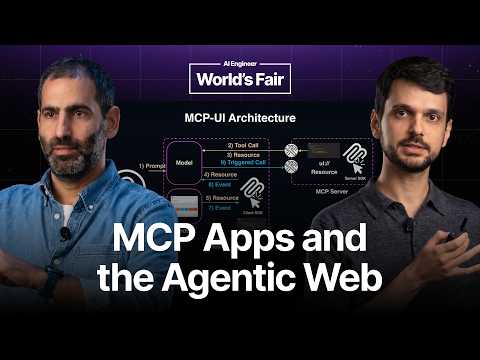
Building the Agentic Web with MCP Apps
MCP Apps standardizes the delivery of interactive, branded UI components from servers directly into AI chat interfaces, replacing text-heavy responses with functional, user-controlled widgets.
 AI Engineer
Charlie Deets on Designing for Utility and Experience
Charlie Deets, designer of Safari and Dia, argues that in an era where execution is commoditized, a designer's true value lies in simplifying complex systems, maintaining clear personal design principles, and focusing on high-level decision-making over getting lost in implementation details.
 Dive Club
Enigma Raises $71M to Simplify Human-Robot Interaction
Enigma is emerging from stealth with $71M to build intuitive human-robot interfaces, using large-scale public experiments to determine how humans naturally want to control machines.
Building Perception Agents for Reliable Human-AI Collaboration
Current AI agents struggle with end-to-end reliability because they lack shared context. Perception agents solve this by observing rendered interfaces and meeting transcripts, enabling them to verify their own work and act on precise visual inputs.
 AI Engineer
Local Agentic Theory for Mobile Games
Moving AI from the cloud to local mobile devices enables real-time, personalized game adaptation and accessibility, provided agents can operate within a 16ms frame budget.
Building in Public: AI Workflows and the Future of Design
The hosts of Dive Radio discuss the messy reality of building AI-powered workflows, the transition from typing to voice-based interfaces, and the importance of maintaining curiosity while navigating rapid technological change.
 Dive Club
Meng To: Building Software with AI and Codex
Designer Meng To explains how he has transitioned to a 0% manual coding workflow by using Codex, local AI agents, and iterative prompting to build complex software products in days rather than months.
 Dive Club
Building Practical Figma Plugins with AI Agents
Avoid cluttering your workspace with redundant plugins. Instead, use AI agents to build custom tools that solve specific, repetitive manual tasks, following a structured prompt formula to ensure utility and maintainability.
 UI Collective
Loredana Crisan on Figma, AI, and the Future of Design Craft
Figma's CDO Loredana Crisan argues that AI is a tool for expression, not a replacement for human intent. The future of design lies in building systems and mini-apps that allow designers to maintain precision and soul in their work.
 Dive Club
Figma Updates: Code Layers, Motion, and AI Agent Workflows
Figma is blurring the lines between design and engineering by introducing native code layers, built-in motion/shader support, and AI-driven agent workflows that connect to external tools like GitHub and Notion.
Apple’s Invisible AI Strategy in iOS 27
Apple is integrating AI directly into existing iOS workflows—such as bill splitting, password management, and notification grouping—to solve specific user problems rather than relying solely on a chatbot interface.
Singles Reject AI for Connection, Accept It for Utility
While 47% of U.S. singles hold negative views toward AI in dating, they remain open to using AI tools for profile optimization and conversation starters, provided the human connection remains authentic.
The Shift Toward User-Controlled AI Recommendation Algorithms
Major social platforms are moving from opaque, one-size-fits-all algorithms to user-tunable systems, leveraging LLMs to allow granular control over feed content.
Using CSS Style Queries for Conditional Theming
CSS style queries allow components to adapt their appearance based on parent-defined custom properties, enabling cleaner, conditional theming without relying on manual modifier classes or JavaScript.
Evaluating Figma AI Agents: Practical Utility and Limitations
Figma AI agents currently excel at generating mobile flows rather than desktop screens, but they struggle to consistently apply local design system variables and styles unless full component libraries are connected.
Building Dynamic Experiences with GenUI and Agentic Workflows
GenUI (Agent-to-UI) enables applications to generate custom user interfaces on-demand using Gemini, allowing for real-time personalization that goes beyond static design.
 Google Cloud Tech
Designing and Building with AI: A Designer’s Frontend Workflow
A practical look at how designers can own the frontend by using AI agents as a force multiplier, leveraging tools like Conductor and Paper to bridge the gap between visual exploration and production-ready code.
Building Functional Personas with AI for User-Centric Decisions
Move beyond static, demographic-heavy personas by using AI to synthesize research into 'functional' personas focused on user goals, tasks, and objections, then making them interactive via custom chatbots.
Building Interactive 3D Websites with Claude Code
Learn a practical workflow for building high-end, 3D-interactive websites by combining Claude Code, Higgsfield AI for assets, and Vercel for deployment.
 UI Collective
Ron Goldin: Design Leadership in the Age of AI
Design leader Ron Goldin argues that AI has transformed design leadership from a management-heavy role into a 'player-coach' model, where leaders use rapid prototyping to win arguments and drive product strategy.
Showing 30 of 158